
There is this little tool PlantUML that I really appreciate. Maybe because I really cannot draw schemas that look good, but also I like it because I can incorporate schemas and UML diagrams into a source code because PlantUML creates diagrams from the text.
More than UML diagrams.
I will present only some that I found useful in my work.
@startjson
{
  "firstName": "John",
  "lastName": "Smith",
  "isAlive": true,
  "age": 27,
  "address": {
    "streetAddress": "21 2nd Street",
    "city": "New York",
    "state": "NY",
    "postalCode": "10021-3100"
  },
  "phoneNumbers": [
    {
      "type": "home",
      "number": "212 555-1234"
    },
    {
      "type": "office",
      "number": "646 555-4567"
    }
  ],
  "children": [],
  "spouse": null
}
@endjson

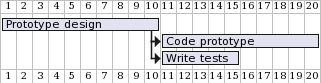
@startgantt
[Prototype design] lasts 10 days
[Code prototype] lasts 10 days
[Write tests] lasts 5 days
[Code prototype] starts at [Prototype design]'s end
[Write tests] starts at [Code prototype]'s start
@endgantt
@startmath
f(t)=(a_0)/2 + sum_(n=1)^ooa_ncos((npit)/L)+sum_(n=1)^oo b_n\ sin((npit)/L)
@endmath
@startuml
digraph foo {
  node [style=rounded]
  node1 [shape=box]
  node2 [fillcolor=yellow, style="rounded,filled", shape=diamond]
  node3 [shape=record, label="{ a | b | c }"]

  node1 -> node2 -> node3
}
@enduml

This diagram works pretty well with Doxygen (for c++ documentation), but also with Markdown.
For other diagrams please check plantuml.com.

 Codeist - Software Consultancy and Advisory